 COGWA Members App
 COGWA Events App
 ROKU App
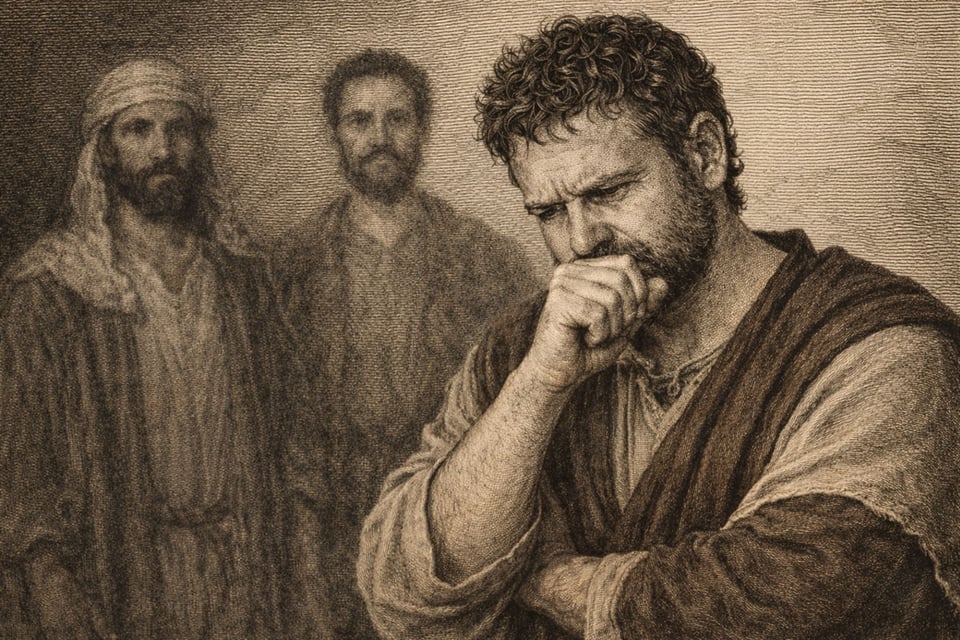
Why Did Thomas Doubt?
Written by James D. Cannon
In a world filled with uncertainty, doubt can easily arise. The apostle Thomas’ journey from doubt to belief offers valuable lessons for us today.
The first verse of our hymn “God Will See Us Through” goes like this:
“We all know doubts and fears, life is full of toil and tears, still we’re told, have no cares, God will see us through.”
Doubt is becoming an epidemic today as a result of the rampant disorder in the world.
Men debate and reason how to best solve global problems. Rumors grow of worldwide economic collapse. And there is never-ending suffering and trouble—starvation, epidemics, nuclear proliferation, violence and mass shootings. Biased media remains a driving confounder of truth.
When man’s attempts to solve these and other cataclysmic difficulties don’t work (or actually backfire), people begin to doubt the soundness of their leaders’ abilities and wisdom. And if they can, depending on where they live, they try to vote these leaders out of office.
Citizens want to replace their leaders with others who will strive to offer remedies for the world’s problems. However, all too often, they, too, do not have the answers.
Doubt has filled the minds of men since the beginning, when Satan tempted Eve and caused her to doubt the veracity of God’s command: Do not eat of the tree of the knowledge of good and evil, lest you die.
The devil is behind doubt
The author of doubt is Satan.
The only real defense against doubt is having a converted mind led by God’s Spirit and being in a close relationship with God every day.
There is an interesting example of a person, not yet converted but called. He was one of the original disciples who would later become an apostle of Jesus Christ.
His name was Thomas.
Let’s take a brief look at the apostle Thomas and see why he wanted proof of the reality of Jesus Christ’s resurrection. Why did Thomas doubt?
Thomas’ background
Thomas was called along with the other 11 men who would become apostles (Luke 6:12-16), with the exception of Judas Iscariot, who was later replaced by Matthias (Acts 1:23-26).
Thomas was with Jesus Christ throughout His earthly ministry. He witnessed the resurrection of Lazarus. On at least two occasions, he saw Jesus feed the multitudes with just a few loaves of bread and fish. He witnessed many of the healings Jesus performed.
Yet Thomas doubted when he was told of Jesus’ resurrection from the dead. He did not immediately believe that the others had actually seen Jesus alive after His crucifixion.
The book of John tells us that Thomas was not with the other disciples when Jesus appeared to them after His resurrection (John 20:24).
Why wasn’t Thomas with them?
Many times, even when we’d be better off with close friends and family, we desire to be alone in times of grief and stress. However, being left alone with our own thoughts can lead to a worse sense of loss and despair.
Was this the case for Thomas? The Bible doesn’t say, but perhaps the death of Jesus Christ was so distressing to Thomas that he felt he had to be by himself to grieve.
The resurrection of Christ
After three days and three nights in the tomb, Jesus was resurrected by the Father and appeared to His disciples.
But, as we already noted, Thomas wasn’t present.
Later, the other disciples told Thomas that they had seen Jesus alive—that He had come to visit them (John 20:25).
Thomas, being the pragmatic man that he was, claimed he would have to see Jesus’ scarred body himself rather than take the word of his fellow disciples.
Was this Thomas having doubt about Christ?
Albert Barnes’ Notes on the Bible makes this comment on John 20:25:
“It is not known what was the ground of the incredulity of Thomas. It is probable, however, that it was, in part, at least, the effect of deep grief, and of that despondency which fills the mind when a long-cherished hope is taken away. In such a case it requires proof of uncommon clearness and strength to overcome the despondency, and to convince us that we may obtain the object of our desires. Thomas has been much blamed by expositors, but he asked only for proof that would be satisfactory in his circumstances. The testimony of ten disciples should have been indeed sufficient, but an opportunity was thus given to the Saviour to convince the last of them of the truth of his resurrection. This incident shows, what all the conduct of the apostles proves, that they had not conspired together to impose on the world. Even they were slow to believe, and one of them refused to rely even on the testimony of ten of his brethren.”
Jesus appears again to the disciples and to Thomas
Eight days later, the disciples were again behind locked doors, but this time, Thomas was with them.
Suddenly, Jesus appeared in the room and exclaimed, “Peace be with you” (John 20:26, English Standard Version).
He asked Thomas to come to Him, to touch the nail imprints on His hands and to place his hand into His side. Thomas, after seeing, said to Christ, “My Lord and my God!” (verse 28).
Thomas then, without a shadow of doubt, believed.
Jesus then told Thomas, “Because you have seen Me, you have believed. Blessed are those who have not seen and yet have believed” (verse 29).
Jesus Christ did not correct, rebuke or scold Thomas. Jesus understood Thomas and his need to see proof. Jesus here helped to ease Thomas’ grief and deep emotional sorrow by meeting him where he was at—and providing him with what he needed.
Lessons for us
There are at least three lessons we can learn from Thomas’ doubting:
- When doubts creep in, we must first draw near to God through prayer and Bible study. It can be very difficult to figure it all out on our own. At the right time, we should confide in and seek help from our close, converted friends or one of God’s ministers.
- We must be humble and honest. Thomas was a man who would not claim to understand something he didn’t. We, too, must be humble enough to admit when we do not understand something, but be open to the impossible.
- We must hold fast to our beliefs. When Thomas was certain, he was 100 percent all in, even to dying a martyr’s death. Tradition says he died as a martyr in India.
Like Thomas, we must stand by our beliefs and know that God is always with us. Remember the example of the apostle Thomas. Draw near to God, be humble and hold fast to your beliefs.